

I. The Practice of Pure Abstraction
What if you were to sit down every day for a fixed amount of time and code a mathematical abstraction? Perhaps the Julia set fractal, perhaps something else. What if you were to do this until your ability to do so was so clear and so refined that it simply became an expression of your nature? How would this change your consciousness, your experience, your life?
What we focus on we become. When one integrates into their practice something as elemental and intrinsic to the universe as pure mathematics, their mind takes the shape of that perfection. In the case of the Julia set, the focus is a fractal. Within it echoes the process of recursion, the principle of the macrocosm within the microcosm, the nature of chaos arising out of simplicity. And all of these qualities we become. They inform the structures of our consciousness and the lens through which we experience the world.
Mathematical coding, as a dimension within our spiritual practice, brings the mind into the form of the mathematical abstraction of our choosing. It is the means by which we cultivate mastery of the mind, so that when we sit down to meditate, the mind with which we must contend is of utter impeccable order. It is as if we are stepping into an impeccable and spacious palace ballroom in which we can dance into the night.
The mind entrained to the mathematics of truth is no longer lost and confused in a web of opinions and judgments. It is no longer ensnared in a collection of fears and desires. Rather, it is yoked to elegance and simplicity, to the complexity that arises out of abstract perfection.
II. Mathematics and Meditation: Not Niche, Universally Relevant
Is the integration of mathematics and meditation a niche discipline, and more so the integration of computer programming? Are they a disjoint collection of disparate interests, or is there some ontological innate order that brings them together in one natural and integrated discipline?
One might think that coding is for technologists and engineers, mathematics for purists and intellectuals, meditation and spirituality for intuitives, for those into the mystical, the metaphysical, the sacred. One might recall their mathematics education as it was presented to them in school and ask: “what could possibly be sacred about that?”
But these disciplines are fundamentally and intrinsically related. Their apparent lack of interconnectivity is simply a product of cultural indoctrination. It’s not innate to their actual nature.
Every human being has the capacity for abstract thought. Within the mind of every human being exists the potentiality of mathematical truth and perfection. And, as every human being possesses the faculty to think abstractly, it is relevant to every human being to cultivate that capacity to think.
Where there is faculty, there must be refinement. We have a body. We must exercise it. We have a mind. We must cultivate it. The one who cares for their mind, who tends to their mind, who cultivates the intellect, enjoys an added dimension of consciousness that the other does not.
The one who employs within a disciplined spiritual practice, mathematics and its natural expression in computer programming, has chosen to refine their faculties of thought. And the one who has done so walks through life with that endowment and blessing, with that embodiment of clarity, so that life may be more profound, more beautiful, and more enjoyable.
This is not a niche practice. This is a practice intrinsically relevant to all of those who have the capacity for abstract thought. It is no more niche than exercise or dancing.
This idea that it is niche and only relevant to the few is a reflection of our cultural inheritance and a cultural indoctrination that sees mathematics as a utility only applicable to students and those who may use it in their careers. It is also the result of the idea that spirituality is antithetical to mathematical precision, to logic, to science, to truth.
Mathematics is truth, and so is spirituality truth. Both exist purely in the realm of mind. Both exist independent of the manifest world of form. Both are discoverable in solitary practice, in the privacy of one’s own thoughts, independent of the need to reference the accumulations of culture. Both are a direct conversation with the universe. Both are intrinsic to the fabric of Self.
III. The Practice of Mathematical Coding
I say unto you, after devoting yourself to a spiritual practice—one that is consistent, one that you revise and refine over time, one that you can return home to on a daily basis—let this practice include meditation as the cultivation and generation of love, as well as a formal exercise in the refinement of the mind through mathematics and computer programming.
In today’s live mathematical coding session, we explored a beautiful fractal known as the Julia Set. The Julia Set exists within the realm of complex numbers, numbers that include real and imaginary parts. A real number is a number that exists between negative infinity and positive infinity. They are numbers that can measure length, multiplicity, and quantity.
Imaginary numbers are born of the question, what number times itself equals negative one? That question must have an answer and therefore produces a new type of number, a number defined by the question itself. It is the imaginary unit. And with this single unit, the real number line opens up into a new dimension of numbers heretofore unknown and unconsidered—a realm of latent numbers, adjacent.
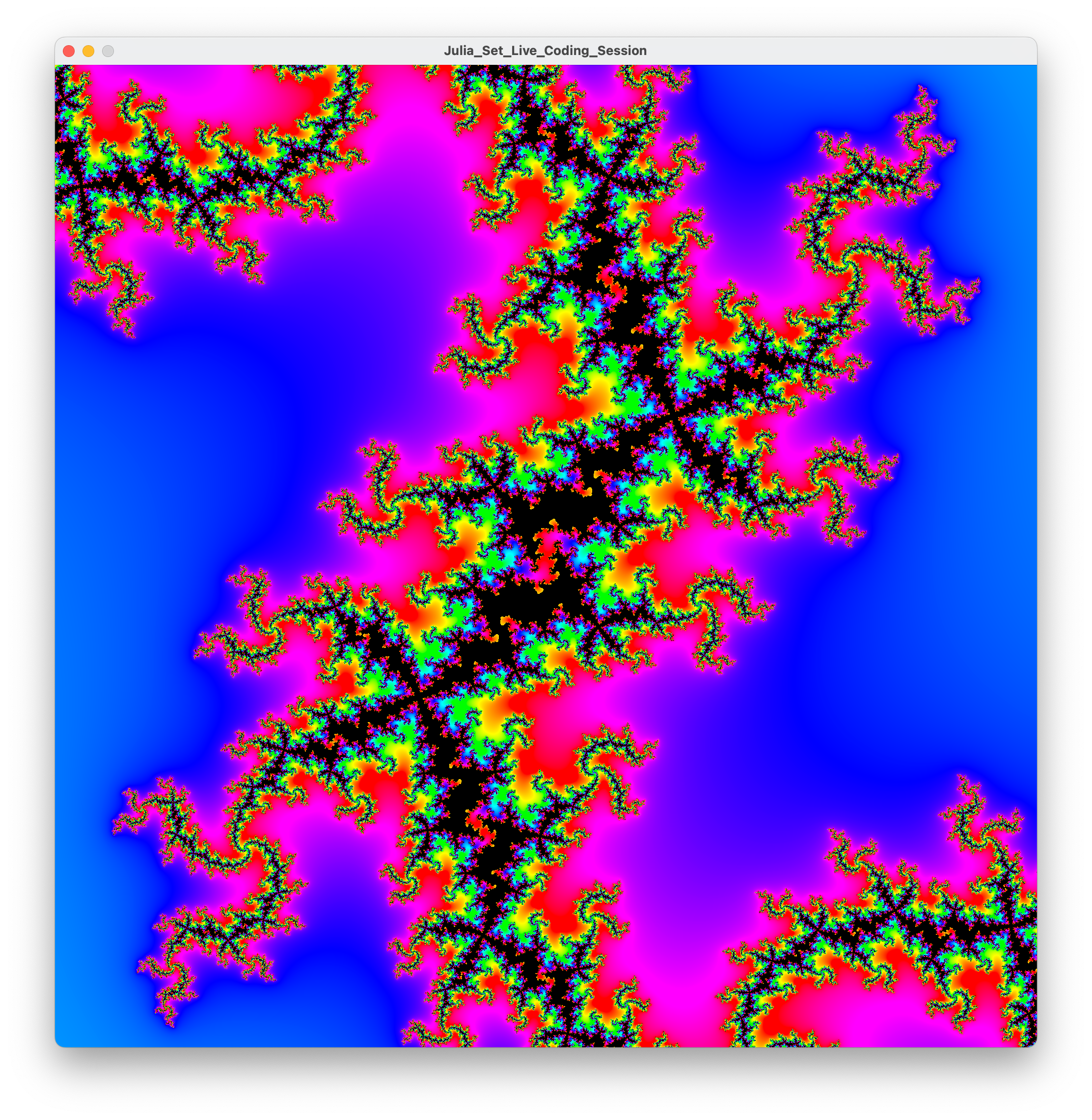
With merely 49 lines of code, we produced the Julia set. We manifested an abstraction hiding for eternity in the fields of dimensionality, waiting for one to look upon its great beauty. With the power of the computer, we as a humanity finally possessed the capacity to generate this mathematical flower in pixels and code.
Living in the soils of the complex plane of real and imaginary numbers, this flower is a fractal and the result of a simple recursive process. Square the number and add a constant. Take the answer and do it again.
This is a recursive definition. If we start with an initial z that is defined by the location of the pixel, and apply the recursion, we see this.
This process applied to every pixel, in which each pixel is assigned a different complex number with which we start, produces the magnificent Julia-Set fractal.
The explanation, in its complete form, takes a few hours. But you can behold here those 49 lines of code that we wrote together. This code gives rise to the complete visualization of the Julia Set.



IV. The Meaning of Sangha
What is Sat-sangha or Sangha? A beautiful word gifted to us by the Sanskrit language. A word that comes from India. A word that means interpersonal association with those who seek truth. One translation could be spiritual community—that is, a community of people who are interested in truth, who are interested in enlightenment, who are interested in greater consciousness. A community of people working on their state of mind so that they may embody the divine, the sacred, the ultimate.
Truth exists in both mathematics and meditation. In mathematics, truth expresses itself as a coherent, logical form. In meditation, truth reveals itself in the immutable substrate of form itself. And Sangha, which is association with truth, naturally includes both.
Sangha is an essential part of spiritual practice in a world bent on so many egoic interests and desires—entertainments and indulgences. The silent humility of truth sits quietly unnoticed by the masses in their occupations. However, with Sangha, we create our own world, our own community. We create our own culture, which becomes a form of curated exposure. We create a culture that seeks truth, a culture consecrated to something greater than the mundane. Something more profound. Something truly subtle.
What the mind is exposed to informs the shape the mind takes. We are greatly included by the culture in which we find ourselves. And when the mind has Sangha—relationships that seek truth—one can more effectively rise into states of divine consciousness.
V. The Three Elements of Sangha
Sangha is comprised of three essential elements.
The first is personal practice, the Personal—that personal discipline in which the individual deepens their connection to sacredness, opens their heart to love, clarifies their mind so that it may perceive truth. In a community of people who have cultivated their inner wealth, the energetic aggregation of the community is deep, powerful, and strong.
The power and consciousness of a community can be measured through the aggregation of the constituent members of which that community is comprised. When a community has a clear defining set of values and practices—values shared naturally and intrinsically by each individual—then the community possesses a kind of coherence that normalize and advance the enrichment of those values.
It is less efficient for a solo practitioner to exist in the world alone with their practice, and that challenge is directly proportionate to the rarity of their values. For they must sustain their values in the winds of indifference and contrary interest. But when a practitioner enters a community, their practice is bolstered by the likeminded practice of others.
The second is gathering, the Intra-personal—the periodic gathering of a group to share in a collective experience or practice. This is a time when the practitioner joins their peers in community, where they offer their state of mind and cultivation to the collective. In group, we have a capacity for shared experiences that our practice affords us to understand and appreciate. For it is when individuals meet with the same depth of consciousness at the same time that true connection emerges.
It seems that we all require some degree of community. We cannot live in complete isolation. When Sangha exists, we can satisfy this necessity by stepping into a community that is not antithetical to our values of practice, and rather strengthens and expands upon it.
The third element of Sangha is interconnectivity, the Inter-personal—the one-to-one relationships that develop between individual practitioners, the friendships, the moments, the hugs, and the care that grow between two souls who share a love for one practice, for one ideal greater than themselves, greater than either of them.
One may think of Sangha as a piece of cloth. Every fiber within the cloth represents a practitioner within the Sangha on their respective path. The complete cloth is the Sangha as a whole, and the weave, the interlacing, are the individual relationships.
VI. Re-Enthroning Mathematics
I invite you to remedy mathematics—to re-enthrone it in our society and in your life—to return it to its rightful place as a cultivation of the faculties of mind and an inquiry into truth, to rewrite the narrative that mathematics is utilitarian, and replace it with the ancient and natural sentiment that mathematics is in the stars.
It matters not whether you have enjoyed mathematics in the form it has been presented to you, whether or not you feel you are adept in mathematics, for all that is the past colored by a cultural impression that is not true or real. This is your life and this is your mind, and mathematics is the pure structuring of mind, pure abstraction. Reclaim your cosmic gift and dust it of scholastic corruption and societal confusion.
When mathematics is pursued as a cultivation unto itself, a practice done for its own sake—like dancing or surfing—then you may discover within mathematics something far more enticing than you have before. When mathematics is not a means to an end, not an imposition upon your self-worth, not a superficial endeavor, not encrusted in pretense, but rather its natural crystalline form, then mathematics becomes deeply meaningful to the human being.
From the first moment of practice, you can experience an augmentation of mind, an immediate improvement in lucidity, an awakening of the attention field, a stabilization of the mind. For what you focus on you become, and when you focus on mathematics, which is perfection, simplicity, elegance, and truth, you immediately become something more.
VII. The Futuristic Human Being
What could be more futuristic than a human being who has cultivated both mind and heart? A human being who practices mathematics and meditation, who is aware of the subtleties within abstraction as well as those within energy, metaphysics, and consciousness.
A futuristic society—a utopian society—requires both the outer advancement and the inner, that is, a world that possesses profound technological proficiency and also the human beings capable of inhabiting that technological richness with wisdom, clarity, love, freedom, peace, truth, kindness, humility, and light.
A futuristic human being is one who has cultivated a multidimensional intelligence. They know themselves and they are free—both in their form as persons and predilections and in their formless as spirit and eternity. They are intuitive and they possess faculties that border The Magical. And they possess a mind that is refined—a mathematical capacity that augments their subjective experience of consciousness by enriching it with a degree of intellectual subtlety, rigor, and order.
One who has studied math beyond rote memorization and mechanical technique, and moved into a comprehension based upon self-evidence and direct perception, the apprehension of mathematical truth that is simple and clear, the result of a meditative mind, a lucid mind, a quiet mind.
Futuristic beings who are refined in both mind and heart while simultaneously being supported by technology and its abundance, can truly be present with each other, can share magical moments together in limitless possibility.
VIII. Changing Society Through the Individual
Society is not outside of us. Society is made of innumerable human beings who, in their aggregation, constitute the collective. The means by which society can change is through the change of each individual. And no one can change an individual but themselves.
We must choose love and cultivate it. We must choose intelligence and prioritize it. The currents of society are moved by the individuals as collective.
It is by changing ourselves that we produce a change in the world. And it is that change that we can enjoy in this generation. And it is that change that we can gift to the next generation.
IX. An Invitation to Sangha
The significance of an augmented society is thus. Our experience of life is influenced by the environment in which we find ourselves. Society is that environment. When our environment is conducive of the highest state of mind, the most loving shape of heart, then we can rise to the apex of beauty, freedom, and intelligence.
Happiness is not a function of things and circumstances outside of us, but rather a function of the inner dimension of state-of-mind, of the topology of our consciousness, of the degree of our awakening.
So I invite you to change the world. I invite you to change your world. And I invite you to change the world for future generations by joining me in practice, and in Sangha. Sangha of this futuristic variety, where the human being is rich in both mind and heart—in mind, body, and spirit.
In this association, we can reach a human potential heretofore not seen in more than just one brilliant spark of an individual, but in an entire group—one worthy of a futuristic humanity.
Namaste,
Thank you for reading. If these teachings resonate with you, you’re welcome to explore my other work.
With Love and Gratitude,
Adam Wes
The Bhakti Math Guru